Industrial Food Processing Solutions with Customized Blades
Precision in food processing is often determined by the geometry of the cutting tool. When standard straight knives fail to handle complex organic shapes or sticky textures, irregular blade designs become essential. These specialized tools are engineered to navigate the intricate requirements of pre-packaged food, meat processing, and high-end bakery production, where deformation and material waste are critical concerns. From curved edges for poultry decomposition to serrated profiles for delicate pastries, the right tool ensures consistency across automated production lines.
For industrial operators, the challenge lies in balancing material hardness with corrosion resistance and non-stick properties. Whether it is cutting frozen dough at -10 ℃ or processing soft tofu with hydrophobic coatings, the intersection of metallurgical expertise and geometric precision is where operational efficiency is won. By integrating customized blades into their workflow, manufacturers can reduce adhesion rates and achieve micrometer-level precision in high-speed packaging environments.

Engineering Irregular Blade Geometries for Diverse Food Processing Scenarios
Irregular blade designs are not merely aesthetic variations but functional responses to specific biological and material challenges. In meat processing, for instance, curved and wavy blades are utilized to accurately section irregular ingredients like chicken feet or fish fins. These geometries allow a single machine to adapt to various processing needs, significantly increasing the throughput of pre-made food ingredient lines.
Automated production lines further leverage shaped blades for fine decomposition. When integrated with hanging chain conveyor systems, specialized blades can execute bone removal and wing separation for poultry with a capacity of 800-1000 units per hour. This level of automation requires extreme dimensional stability to ensure safety and precision at high speeds.
In the bakery sector, the focus shifts to avoiding structural deformation. Serrated shaped blades are employed to slice cakes and puff pastries, maintaining a cutting flatness error of ≤ 0.2mm. Furthermore, specialized low-temperature anti-sticking designs are critical for frozen dough, preventing the material from adhering to the metal surface and reducing product damage during high-volume conversion.

Material Science and Surface Technologies for Food-Grade Cutting
The selection of the substrate material is the first line of defense against wear and corrosion. For basic vegetable cutting and packaging film, 301/302 stainless steel provides a cost-effective solution with HRC 50-53 hardness. However, for meat and baking applications, 4Cr13 martensitic stainless steel is preferred, offering a 30% increase in wear resistance with hardness reaching HRC 54-56.
High-load scenarios, such as slicing frozen meat or cutting composite films, demand advanced materials like White Steel (W6Mo5Cr4V2) or Tungsten Carbide. Hard alloys, created through sintering tungsten carbide and cobalt, achieve hardness levels of HRC 88-92, extending tool life by 5 to 8 times compared to standard steel. This is particularly vital for bone-processing tools where lifespan often exceeds 8,000 hours.
Surface treatments further enhance performance. Titanium-based coatings (TiN/TiAlN) reduce friction coefficients by 30-40%, which is essential for sticky substances like cheese and soy products. For environments requiring CIP (Clean-in-Place) cleaning and high-temperature steam disinfection, Chromium Nitride (CrN) coatings ensure the tool remains corrosion-free while maintaining a surgical edge.
Integration with Industrial Equipment and Operational Compatibility
The effectiveness of a blade is dependent on its compatibility with the driving machinery. In central kitchens and meat processing plants, chopping and mixing machines utilize a combination of curved and straight knives to achieve perfect emulsification of minced meat. Similarly, meat grinders employ irregular "nine-shaped" blades to adjust slicing thickness based on the specific density of the meat being processed.
Packaging machinery requires a different set of tolerances. Blades used for aluminum foil and composite films must operate with micrometer-level precision (± 0.0005mm) to ensure burr-free edges. For snack packaging, dotted blades are used to create easy-tear lines, where the cutting depth is precisely controlled to 1/3 to 1/2 of the material thickness to prevent accidental punctures.
Dairy and soy processing introduce thermal variables. Cheese cutting often employs constant-temperature blades (10-15 ℃) with obtuse angle designs to produce ultra-thin slices (0.2-1.0mm) without residual debris. In tofu processing, hydrophobic coatings are applied to the surface to reduce food attachment by over 40%, ensuring a clean cut and reducing waste.
Technical Specifications of Food-Grade Irregular Tooling
| Material Type | Primary Application | Key Advantage | Typical Hardness |
|---|---|---|---|
| 301 Stainless Steel | Fruits, Vegetables, Films | Low cost, High maintenance ease | HRC 50-53 |
| 4Cr13 Stainless Steel | Meat and Bakery | Increased wear resistance (+30%) | HRC 54-56 |
| High-Speed Steel | Frozen Meat, Composites | Thermal collapse resistance | HRC 62-64 |
| Tungsten Carbide | Bones, Superhard Foods | Extreme lifespan (8,000h+) | HRC 88-92 |
| 440C Stainless Steel | Dairy and High-End Baked Goods | Balance of corrosion and sharpness | HRC 58-60 |
Strategic Selection and Maintenance for High-Intensity Operations
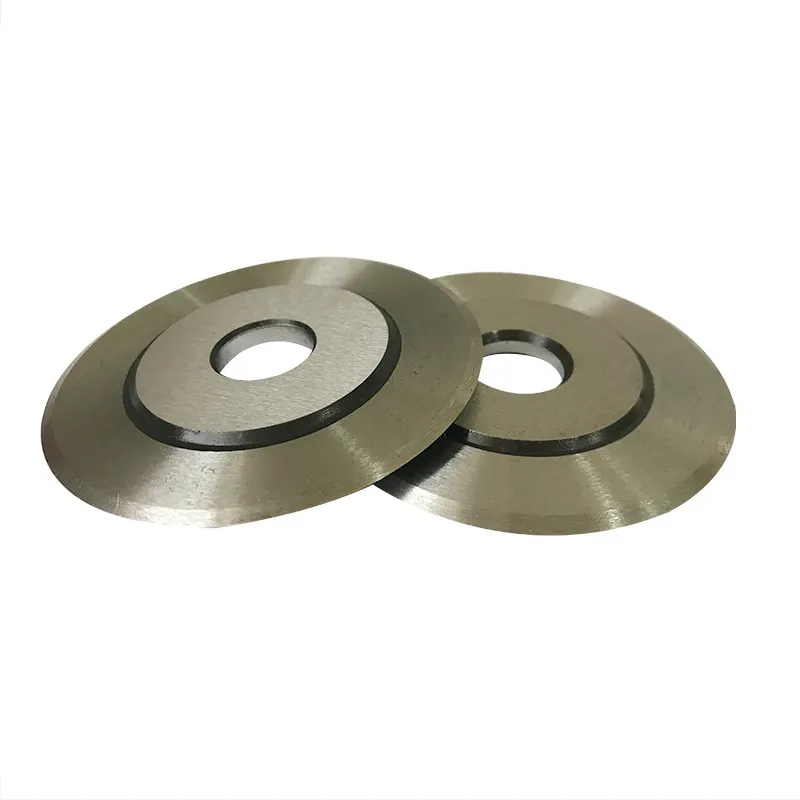
Selecting the correct cutting tool requires a detailed analysis of the frequency of use and the material characteristics of the food. For high-frequency industrial scenarios, procurement managers should prioritize hard alloys or titanium-coated options to minimize downtime caused by sharpening. When dealing with specific apertures for mesh blades or precise outer diameters, non-standard customization is the only way to ensure compatibility with existing hardware.
Maintenance is equally critical to ensure food safety and tool longevity. Stainless steel blades must be rinsed of blood stains or food residues immediately after use to prevent pitting corrosion. A strict weekly deep-cleaning schedule is recommended for all food-contact surfaces. For commercial high-intensity operations, a replacement cycle of every 200-300 operational hours is advised to maintain the precision of the cutting edge.
Furthermore, the tempering process plays a silent but vital role. Low-temperature tempering is used to balance hardness and toughness, preventing catastrophic blade fracture under impact loads—a common risk when cutting pork ribs or frozen blocks. By matching the tempering profile to the impact frequency, manufacturers can avoid costly line stoppages.
Future Directions in Precision Food Cutting Technology
The industry is moving toward "smart" cutting solutions where blade geometry is optimized through simulation software before production. Laser micro-level cutting technology is now enabling surface roughness levels of ≤ Ra0.2 μm, which is essential for the next generation of high-speed sealing machines and ultra-thin composite packaging.
We are also seeing a shift toward multi-functional coatings that combine anti-adhesion with antimicrobial properties. As the demand for pre-packaged, ready-to-eat meals grows, the requirement for customized blades that can handle multiple ingredient types in a single pass is increasing. This drives the development of hybrid-material blades—combining a hard alloy edge with a high-toughness steel core.
Ultimately, the goal is the total reduction of food waste. By refining the cutting angle and reducing the "squeeze" effect in soft foods, precision tooling allows producers to maximize the yield per raw material unit, directly impacting the profitability of large-scale food processing enterprises.
Frequently Asked Questions on Industrial Cutting Solutions
What is the main difference between 4Cr13 and 301 stainless steel for food use?
4Cr13 stainless steel is a martensitic steel that can be heat-treated to reach higher hardness (HRC 54-56) and offers 30% better wear resistance than 301 stainless steel, making it more suitable for meat processing, whereas 301 is better for lower-stress applications like vegetable slicing.
How do I prevent food from sticking to the blades during high-speed slicing?
Adhesion can be reduced by using Titanium-based coatings (TiN/TiAlN) which lower the friction coefficient by 30-40%, or by applying hydrophobic coatings specifically designed for soft materials like tofu and cheese.
Can tungsten carbide blades handle frozen meat and bones?
Yes, tungsten carbide (hard alloy) is specifically designed for superhard ingredients. With a hardness of HRC 88-92, it provides 5-8 times the wear resistance of ordinary steel, making it the industry standard for bone-cutting and frozen food processing.
What is the typical replacement cycle for commercial food blades?
For commercial high-intensity operations, it is generally recommended to replace blades every 200-300 hours to maintain precision and safety. For light-duty or household devices, the cycle may extend up to one year.
How is the precision of packaging film blades measured?
Precision for packaging films is measured at the micrometer level, with high-end blades achieving a tolerance of ± 0.0005mm at the cutting edge to ensure burr-free cuts on aluminum foil and composite materials.
Do irregular blades require different cleaning protocols?
While the basic cleaning is the same, irregular shapes (like wavy or grid blades) can trap food particles in crevices. Therefore, immediate rinsing and a thorough weekly deep-clean are mandatory to avoid corrosion and maintain hygiene standards.
Technical References and Industry Standards
- ISO 9001 Quality Management Systems for Manufacturing
- FDA Food Contact Substance Guidelines
- ASTM International Standards for Metallurgy and Steel Hardness
- EFSA Regulations on Food Processing Equipment Materials
For enterprises seeking to optimize their production efficiency, selecting the right cutting geometry is a strategic investment. Our engineering team specializes in translating operational challenges into high-performance metallurgical solutions, ensuring that your production line operates with maximum precision and minimal waste.
Related Industrial Solutions